When I consider printmaking and the use of digital technologies to either further develop my images or used to create further prints. The use of scanning comes to mind, what can happen when something is scanned? I feel I can extend the life of the work and capture them in a moment of time, it makes the work temporal and allows me to reproduce and use as another potential layer in my work.
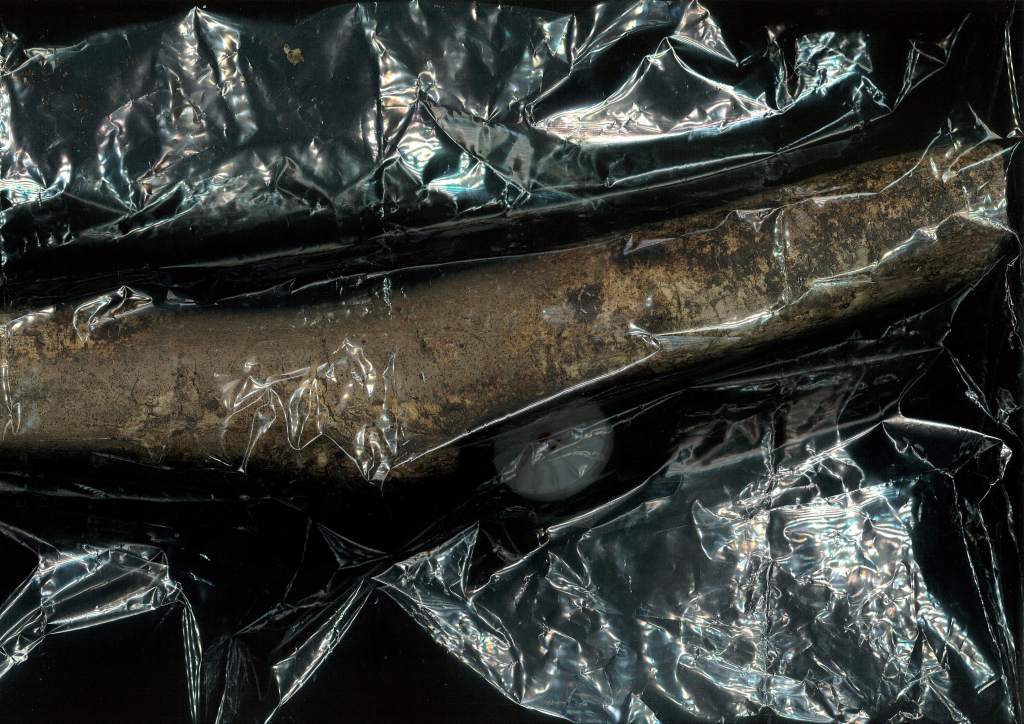
Scan of vacuum packed branch
Taking my work through various processes is central to how I develop my output. My work does not stagnate once it has potentially reached its final form, in fact, the work is pushed further to explore other techniques in terms of how the resulting effects can inform the next stage in my output. I commenced this experimentation by scanning one of my vacuum packed branches using the standard printer/scanners that are located throughout the university building. This method allows me to reproduce an object that is three-dimensional into a two-dimensional reproduced image. I cannot help but think of the tradition in printmaking with regard to the practice of making editions. Can a printer or scanner make editions of work? This question is interesting to me as each scanner/copier will leave its own mark, I can imagine that each mechanism has its own unique flaws. This can be observed when photocopying an image and the track marks that are left, or if a particular machine is running low on ink. There are many variables that can come into play when using one of these tools. I love the idea of using a photocopier to make editions of my prints.....the edition can be never-ending!
        An element of the scan that appealed to me were the various creases and folds in the scanned plastic, catching the light of the scanner. Not only was the scanner taking an impression of the work but the plastic itself was conducting the light in the resulting copy. I wondered what would happen if I removed the branch or all the material together and just scanned.....would I capture some of this light?
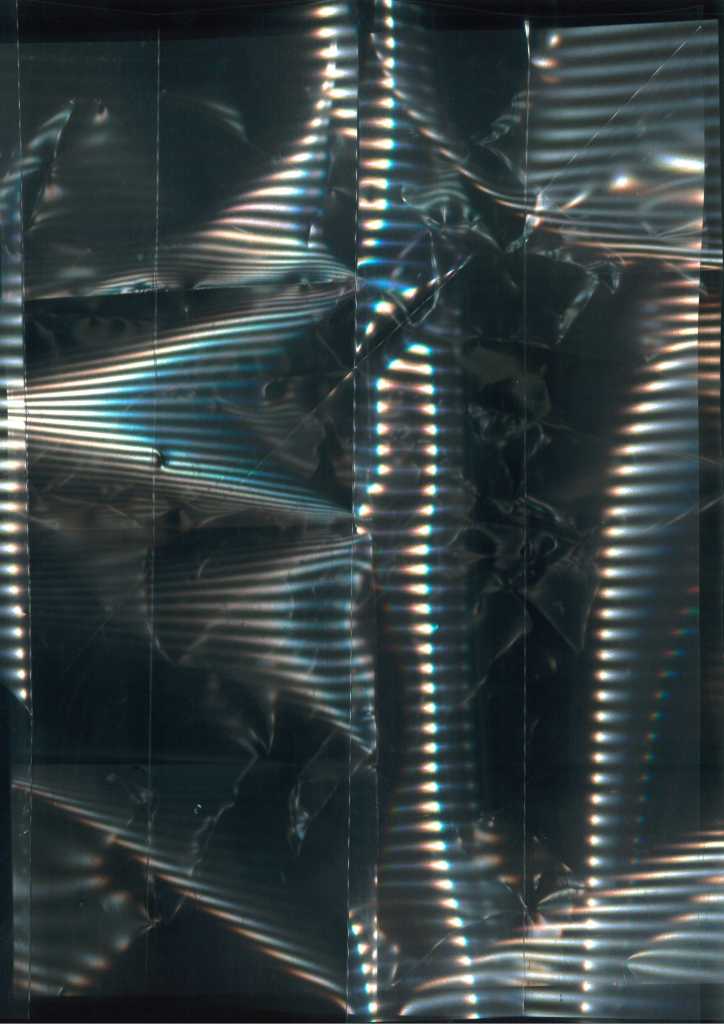
Scan using university copier/scannerScan using HP Envy home printer/scanner
As folding was an initial component of my work, I proceeded to fold sheets of acetate and take them through the scanner. I conducted the same test on my personal printer to compare the results. The scans using the university scanner had an instantly noticeable difference with regard to the light caught and the contrast to the black background. The home scans were nothing like these and produced a grey tone. I then used the home scanner to scan the ambient light of the room. I wanted to see if the machine would capture any of this atmosphere? There were faint impressions of line caught, but the most noticeable aspect was the horizontal repeated lines that appeared, which had a green/purple tone. There are certainly possibilities that arise from experimenting with this process and the scanner appears to have lots of potential for image making, with its variation in output from machine to machine. I will see if I can capture more in future tests by utilising the flatbed scanners in photography.




Leave a comment