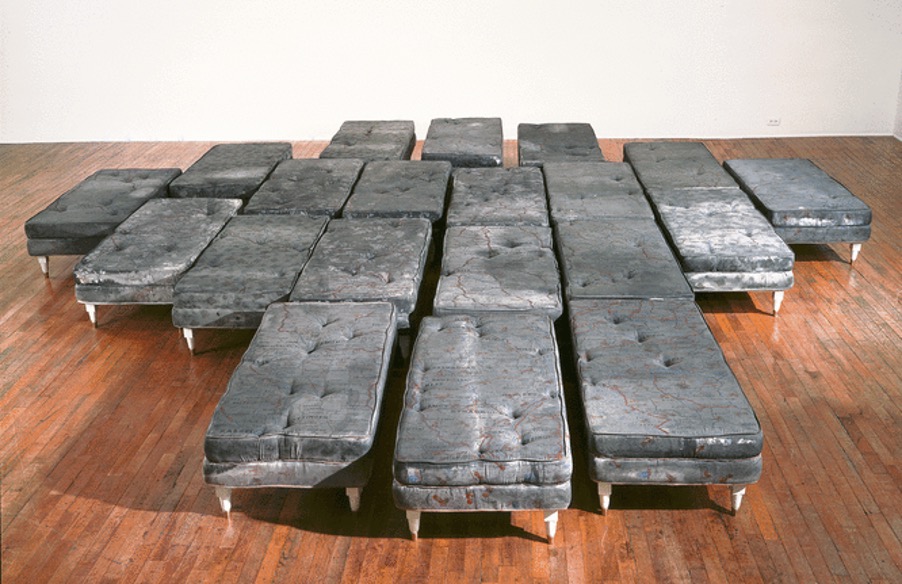
I came across this essay (Guillermo Kuitca, Grids and Models in Argentine Culture by Melissa Sesana) when conducting a google search for my dissertation research, the title contained  the grid which instantly grabbed my attention, so I had to have a read. The grid is an element that appears throughout my work and a mechanism that I comment on regularly. The grid has become a prominent feature as I have progressed my project and as I near the later stages of my degree. The below image captured my imagination and provided me with ideas of how I may display my work. There was no drawn grid, but the system was used to arrange the mattresses. The arrangement gave them a uniformity and linked the objects together to create a cohesive piece. As I have been exploring the potential of displaying my work on the floor, this made me consider how I may display my intended hybrid canvas prints. They have a depth to them so would gain a three-dimensional quality  when displayed on the floor. I feel this arrangement works with my concept of fragmentation, as where there is little space between the items in the below image, I would look to create more distance between the objects and create a more disjointed arrangement.  The link to painting with the grid is interesting, where this feature resurfaced in the 1900s as a central subject matter within painting itself.
        The essay progresses to discuss the grid as a tool for examining the relationship between people and space. I would say that the grid has become less rigid and moveable, it provides a schema for organisation, such as producing maps, blueprints or floor plans. Kathryn Brown’s “The Artist as Urban Geographer” (2010) analyses this contemporary twist, suggesting that in the twenty-first century artists,"transform the pictorial and interpretive conventions associated with the grid and suggest ways in which its figurative space can make visible diverse relations between individuals, communities, and the city. As a result the grid becomes a dynamic structure capable of communicating a variety of subjective experiences of the urban environment."What I find interesting is the linking of the grid to the building / home. I have observed the grid in the surroundings around me whilst studying at London Met; the buildings as I walk from the tube station to the studio, the parkay flooring and the grid of the windows. These elements have all seeped into my conscience as I have navigated by work.
Guillermo Kuitca, Untitled, 1992, acrylic on mattress with wood and bronze legs, 20 beds.

 Marco Carofalo ART
Leave a comment