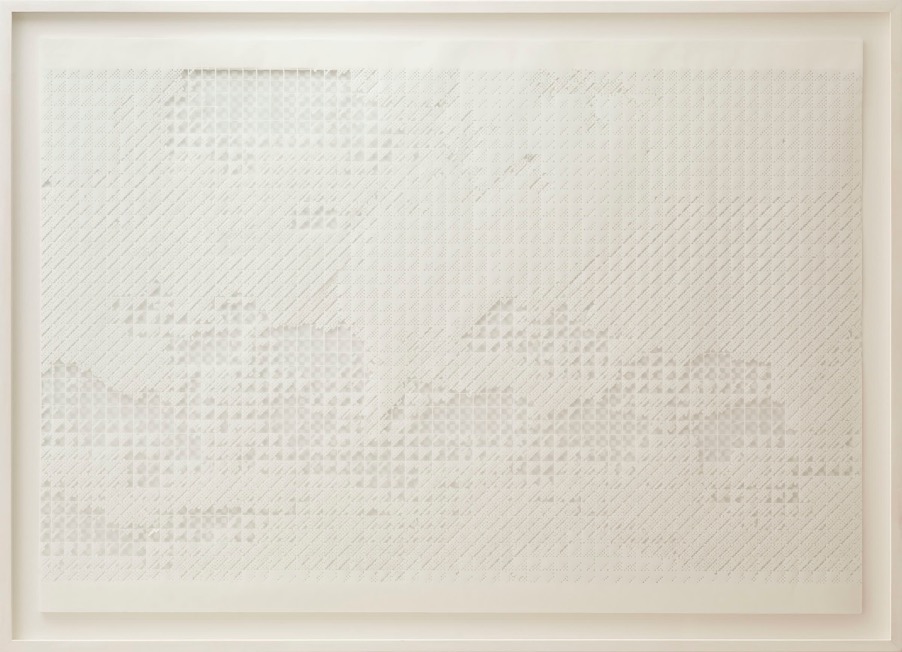
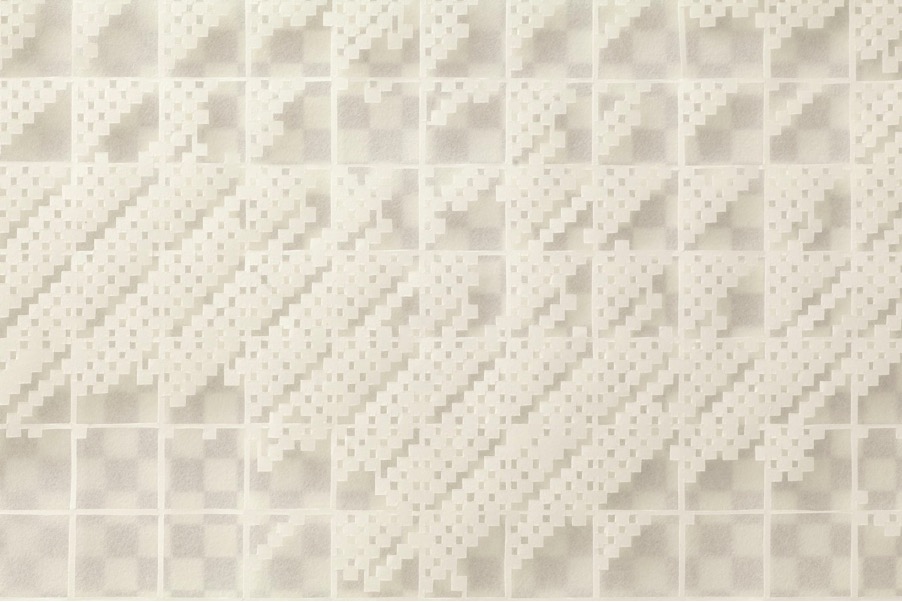
I was recommended to look at the work of Caroline Jane Harris by Rebecca Edwards, Arebyte due to the nature of how Harris worked. It was interesting to look at her work as there are similarities using pixelation, however, we approach are work in very different ways. I like the relation in the work between digital device and printed form. This is something I am exploring in my practice in terms of how digital aids interpret my marks. Harris collects photos taken with a phone camera and uses these to form a foundation to her work. Harris then blows up the image in low resolution and uses this as a layer in her work. What I find interesting is that Harris then cuts out the layer of pixels which is then overlaid over a similar image of higher resolution to create a lattice effect, the top cut layer looks like a different material altogether, something akin to lace. Harris is obviously interested in this methodical making process as a type of contemplation.
        My work is far more instinctual, where I am considering the print possibilities of the pixel and using this to drive further works. What the work does help to inform is other possible iterations of my work. I have already been masking and using fragments of prints to observe the serendipity in the making process and could use this method at a larger scale to cut-out sections of prints. I have already been mining my initial folded prints, where I have then adhered these to canvas to craft my hybrid prints that blur the boundaries between printmaking and painting. The layering method employed by Harris is thought provoking and could be harnessed as a point of departure in my work; could elements be cut-out and hung floating in-front of each other?
A Stopped World, 2020, 16 hand-cut layered digital prints.A Stopped World, detail.Deep, Slow, Still I, 2020, hand-cut layered paper and digital print.Deep, Slow, Still I, detail.


 Marco Carofalo ART
Leave a comment