
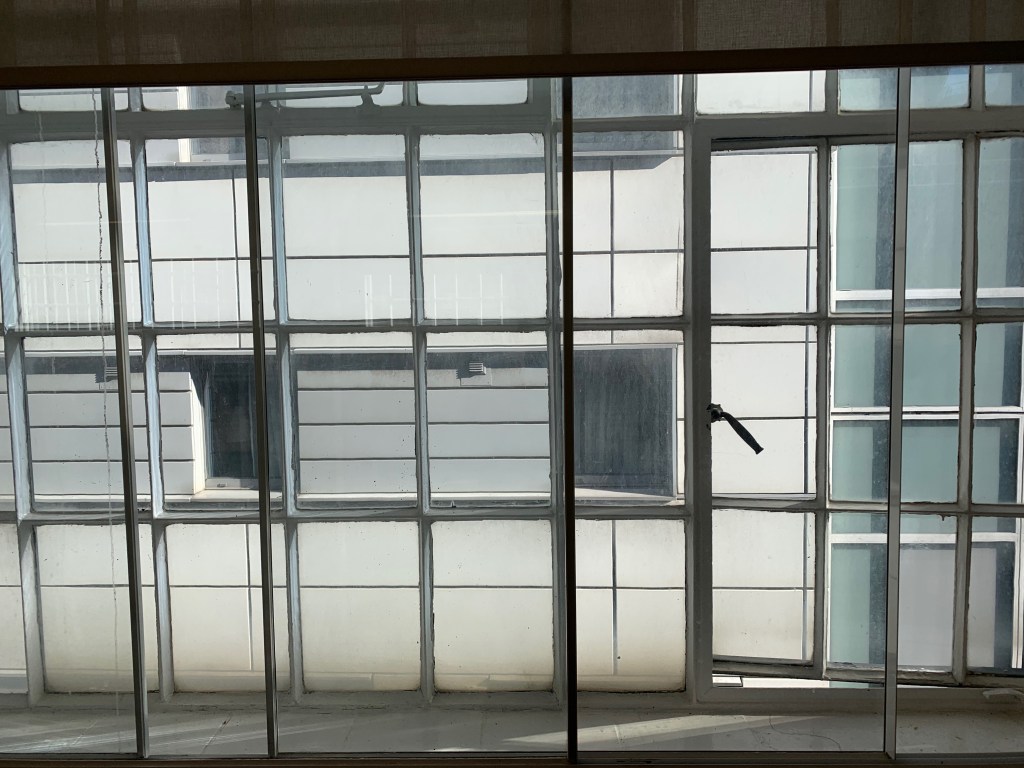
The window continues to be a great source of inspiration for me, I am constantly surrounded by the grid of the frame as I navigate the studios and the surrounding London area. The buildings, the windows, the pavements and constant activity of construction is all permeating my thought process. This repeating form is an interesting concept for me and provides clues as to how I can display and formulate my work. I have been working further with the grid in my work and how this structure appears in my digitally manipulated imagery. The window acts as a gateway, a divided as such, for me and the outside world; it is the mechanism that instigates the dialogue between these spaces in my work. As I continue to work with the grid I start to consider the canvas, the place that the works manifests. It is an interesting journey I am on, and how the work develops from the physical plane to the digital realm. This has lead me to start looking at the work of Agnes Martin and the repeated grid structures she works with. Repetition is also an intriguing principle, as this is a core aspect of printmaking, which is the primary process I engage with. The notion of the edition is a repeated process, which then makes me contemplate alternative methods of repletion production.
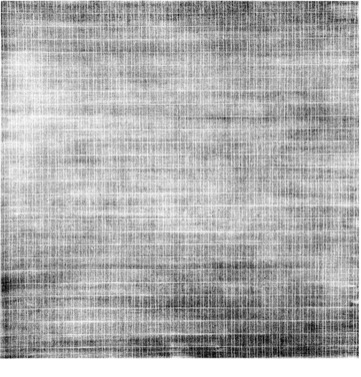
This black and white image is from the essay The Originality of the Avante-Garde and other Modernist Myths by Rosalind E. Krauss, 1986. What was striking for me instantly was that the image looked like a photocopy and presented the work in a very different way. There were shifts in tone throughout the canvas, especially in the bottom right. The copy of the original work gave it something new and makes me consider how the process of photocopying can produce copies of work - editions as such in a new digital way and is a tool for exploring my images in. The photocopier for me is not just a way to copy an image but is a tool in its own right that interprets the original image that is fed through its mechanism. I often photocopy elements of my work to enlarge or observe what happens. Interesting marks emerge and interpretations my the copier come to the front, much like the above image by Agnes Martin.
The essay in itself throws up a poignant viewpoint for me, that of the origins of an artwork and that of the canvas.
The grid’s power lies in its capacity to figure forth the material ground of the pictorial object, simultaneously inscribing and depicting it, so that the image of the pictorial surface can be seen to be born out of the organisation of pictorial matter. For these artists, the grid-scored surface is the image of an absolute begining.
The above suggests that the grid is the start, the beginning of something, and is a concept that is constantly being repeated and rediscovered by artists. It is something that is new but old at the same time and vibrates through the artists psyche. The gird is then like a canvas and for me the question of what is a canvas makes me consider how my work will be displayed and developed. Interestingly, I am moving away from the canvas, if we consider the canvas to be a physical object, and to that of the digital canvas. It is a concept that I find thought provoking and one that I will work back and forth to and then we are back to the window, the divider between inside and outside and that of the physical and digital world. The window can be perceived as the computer monitor screen that acts as the conduit to work on a new canvas (the digital program).
 Marco Carofalo ART
Leave a comment