Attempting to make printmaking plates using the laser-cutting machine has proven to be a challenging and lengthy process. The lead time to craft a matrix can be a number of weeks due to the availability of technician staff and the limitations of the process. Plates can only be produced to a certain size and there is a limit on the length of time the laser-cutter can be used to fashion the desired image. These restrictions have made me consider other routes for exploring my images and how I can increase the scale of the work.
        I have always wanted to make large one-off prints/plates that explore the making process and considering screen-printing could be a potential solution. When I consider my work and the future of my practice, printmaking is at the core of how I seek to position myself as an artist. Therefore, considering editions should be something I engage with. I am not drawn to the rigidness of the edition but I am interested in what an edition can be and how this can interrogate my practice.
        Learning the screen printing process has been extremely enjoyable and something that I totally dismissed in the past. There is a painterly feel to the process when the vast amounts of ink saturate the printing screen and the engagement of my body and the energy transferred through the squeegee transfer the image onto paper. I instantly start to think how this process can be manipulated and disrupted. There is also a link to the digital here, where in order to make the screen my imagery has to be turned into a halftone image using photoshop. Therefore, the screen-printing process seems adapt to exploring my digitally manipulated work and offers another process for the work to navigate through.
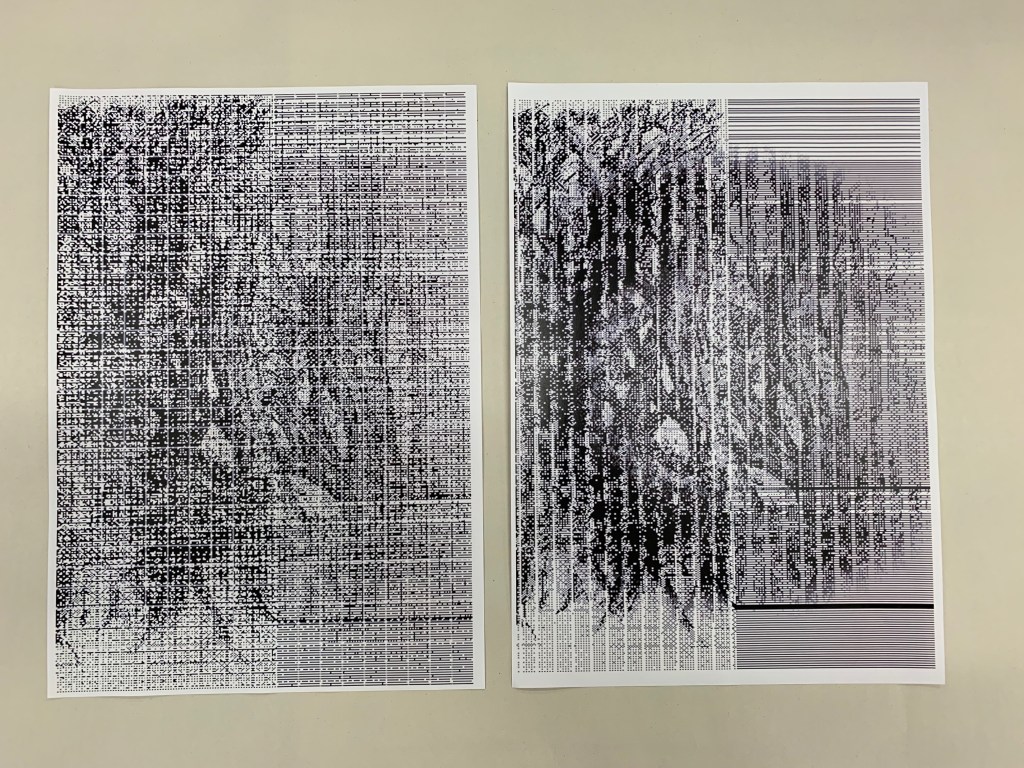
Positives for creating screen-printing screen
The above image shows my drawing that has gone through various digital programs, where I am trying to capture the point when the screen flickers and flexes to produce the grid-like effects I am so drawn to.
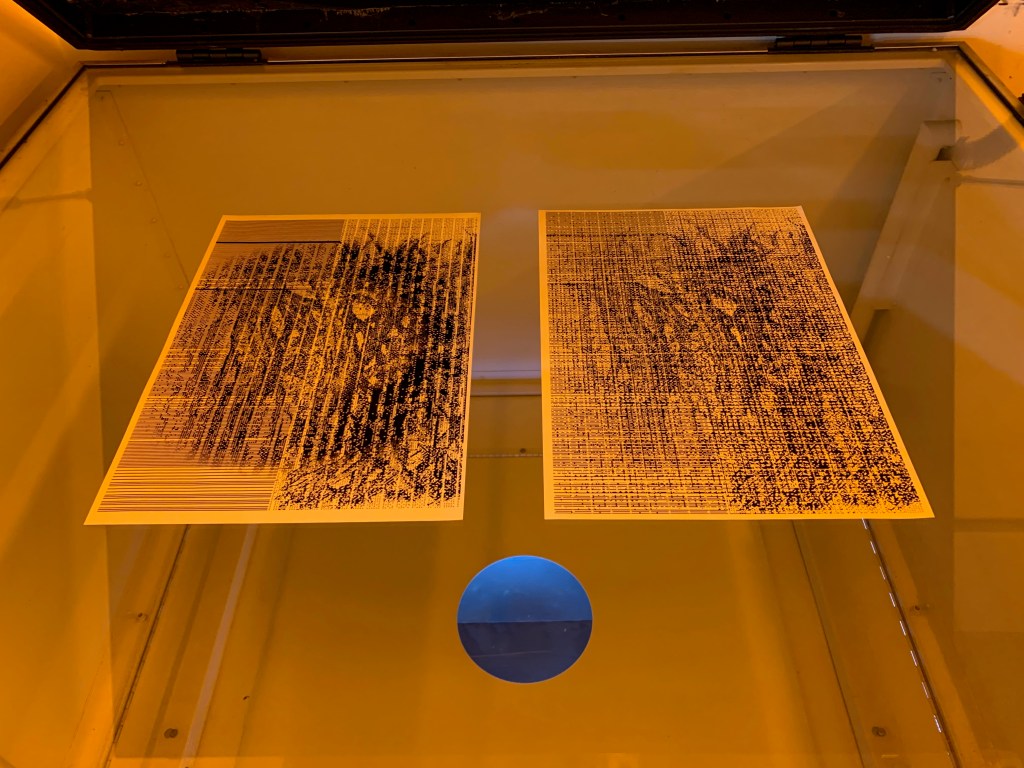
Placing the positives for exposure
Once the screen has been prepared by cleaning and removing the previous students images, the screen is coated with photo-emulsion and once dried is placed on top of the positives for exposure.
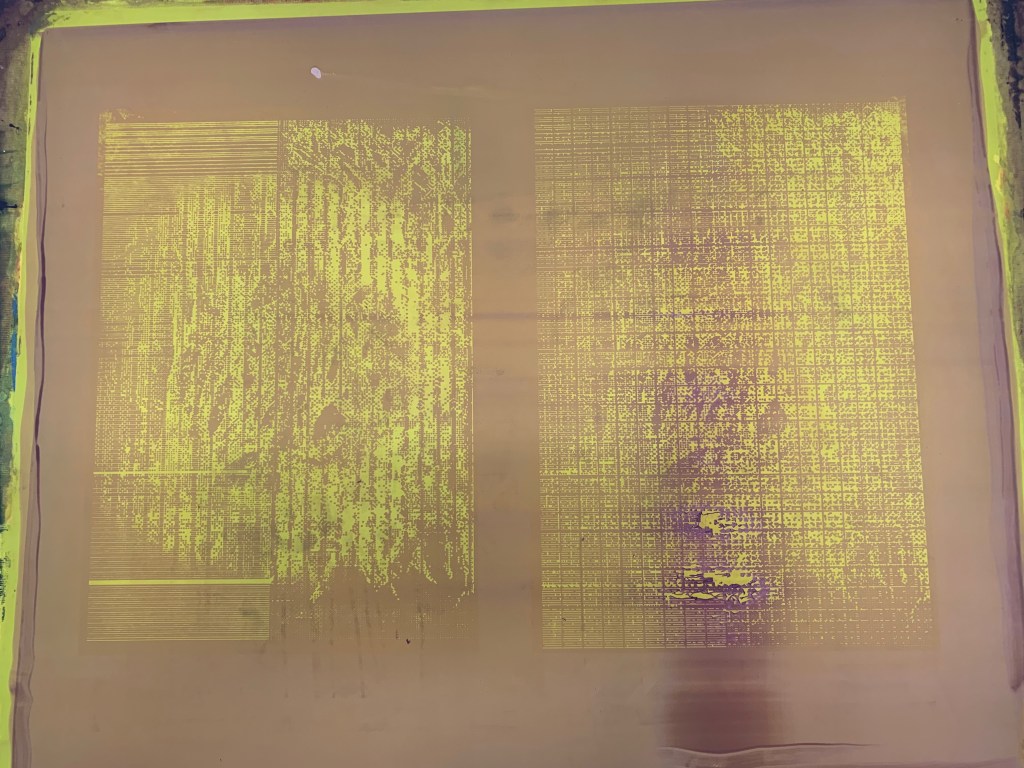
Exposed screen after jet-washing to reveal the image
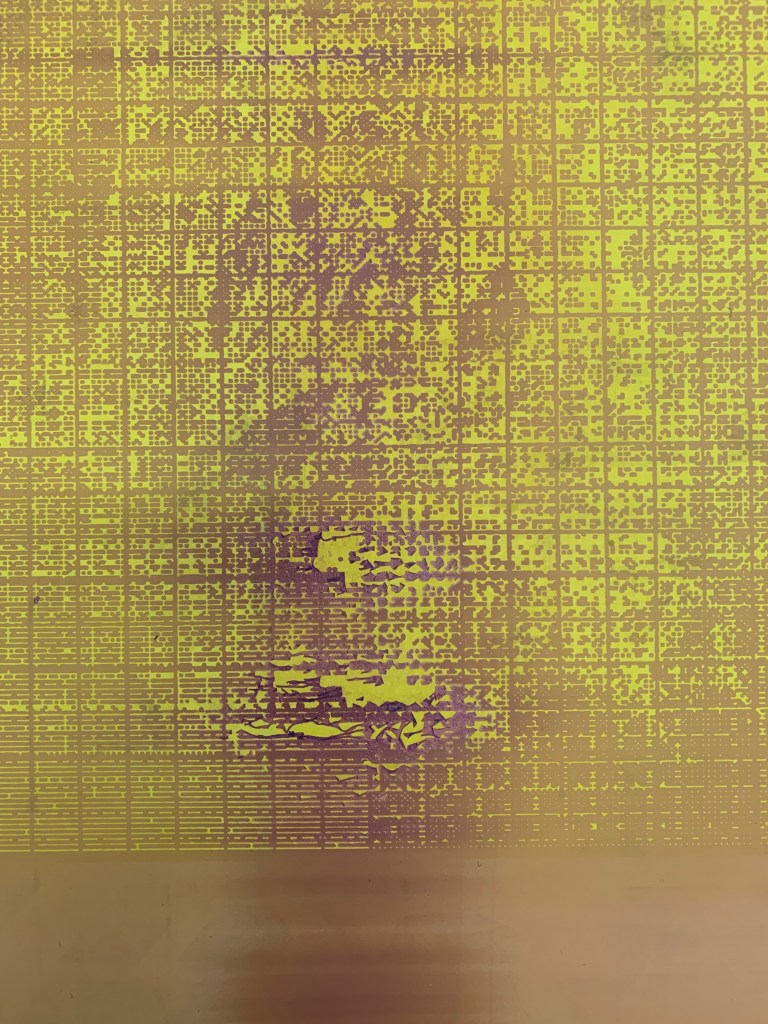
I find this process of preparation very demanding on my body due to the issues I have with my hands and arms, however, sometimes this weakness has its own interesting results. I have particular problems with my dexterity so when holding the troff to apply the emulsion was very difficult and resulted in me applying it too thickly in an area on the screen. Rather than wash out the image and expose again I decided to embrace the defect in the screen. My work is all about the process of making and therefore, the physical difficulties I have all make up part of this journey.
Detail of screen where photo-emulsion has been applied too thickly and resulted in the exposed image start to peel away
The defect on the screen only applied to one image so this would allow me to observe the differences in print.
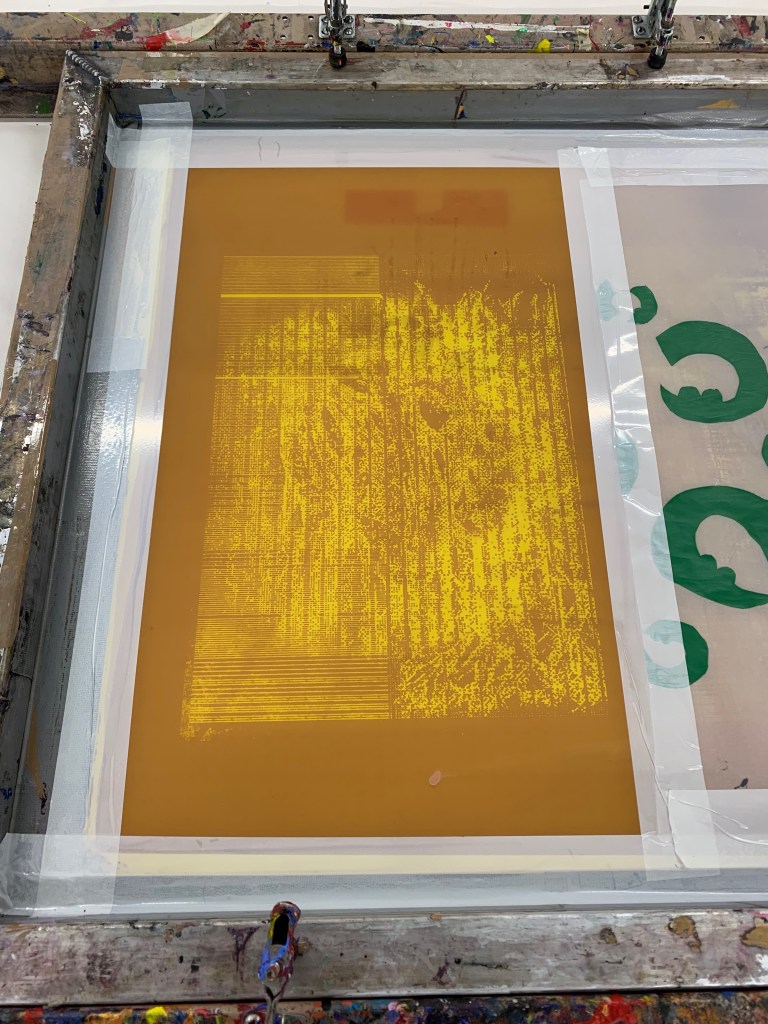
Masking half the screen to print the desired image
More than one image can be applied to a screen and I could mask off each section in order to see how each image printed when screen-printing.
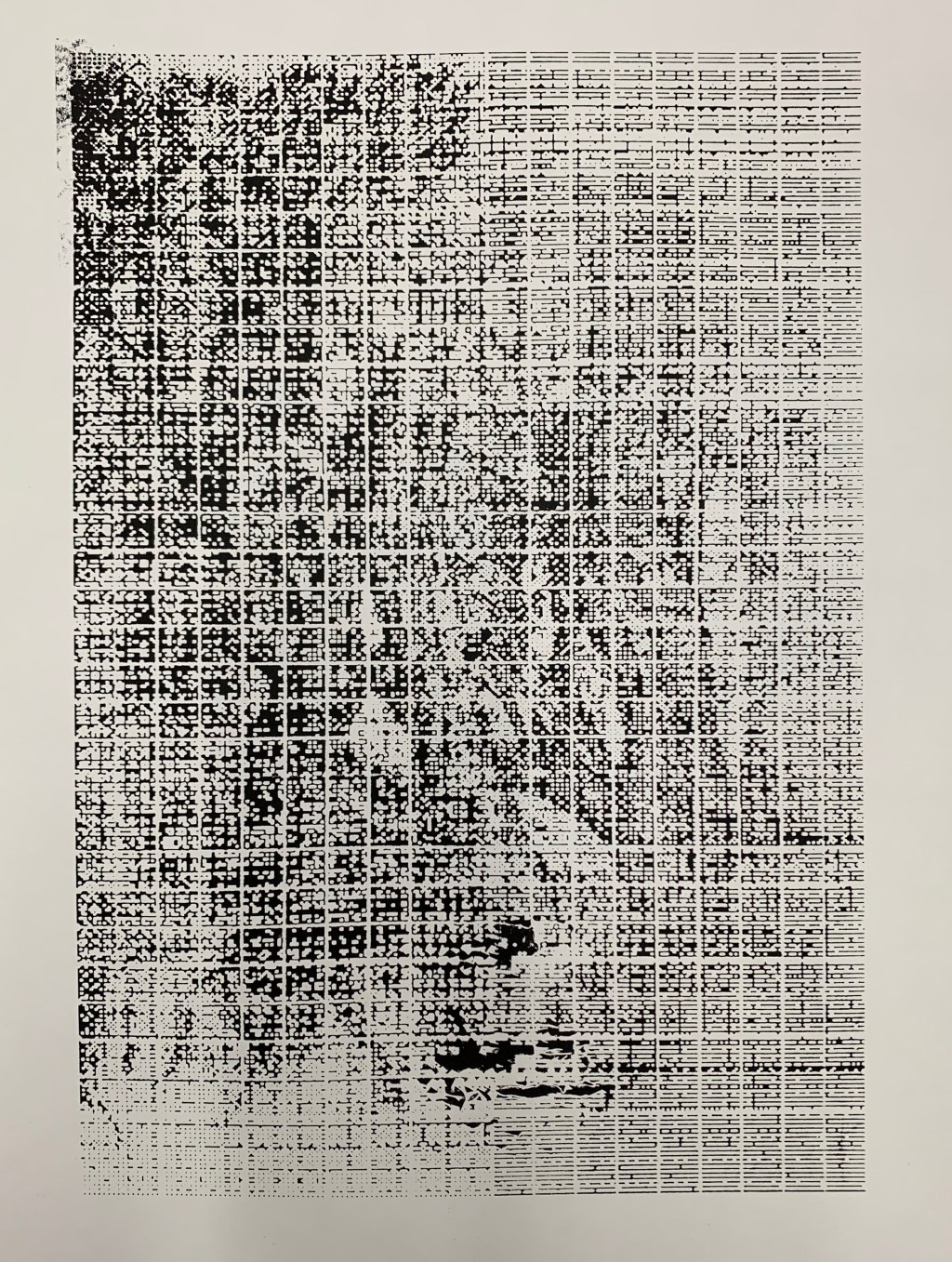
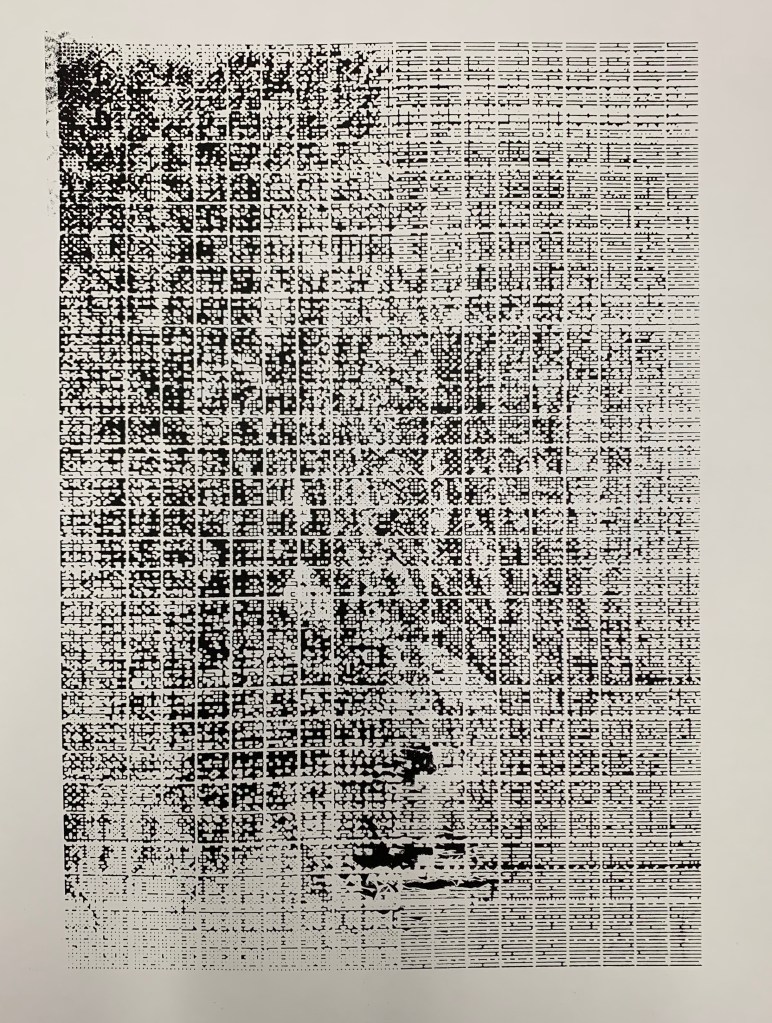
Print taken from screen where the defect was
The resulting print taken from the screen which had the defect came out extremely well, where all the fine detail of the pixelated image came through. The section of the print I feel was most successful, was the area that had the imperfection. This area of the print disrupted the pixelated composition and gave an organic feel that contrasted well with the rest of the print. As I continued to work on the screen and work through the ink and cartridge paper I had, I was essentially making an edition of prints. I was getting a feel for the physical process of pulling a screen print and had amassed a number of prints and material I could leverage going forward.
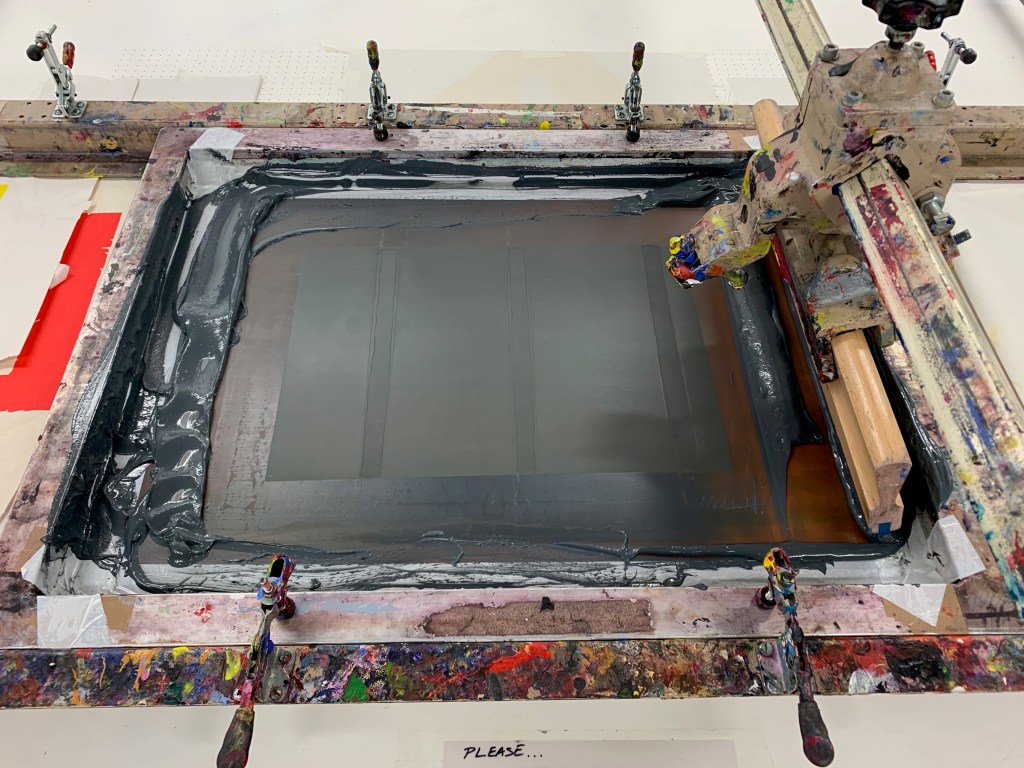
Screen with ink ready to pull a printPrints drying on rack
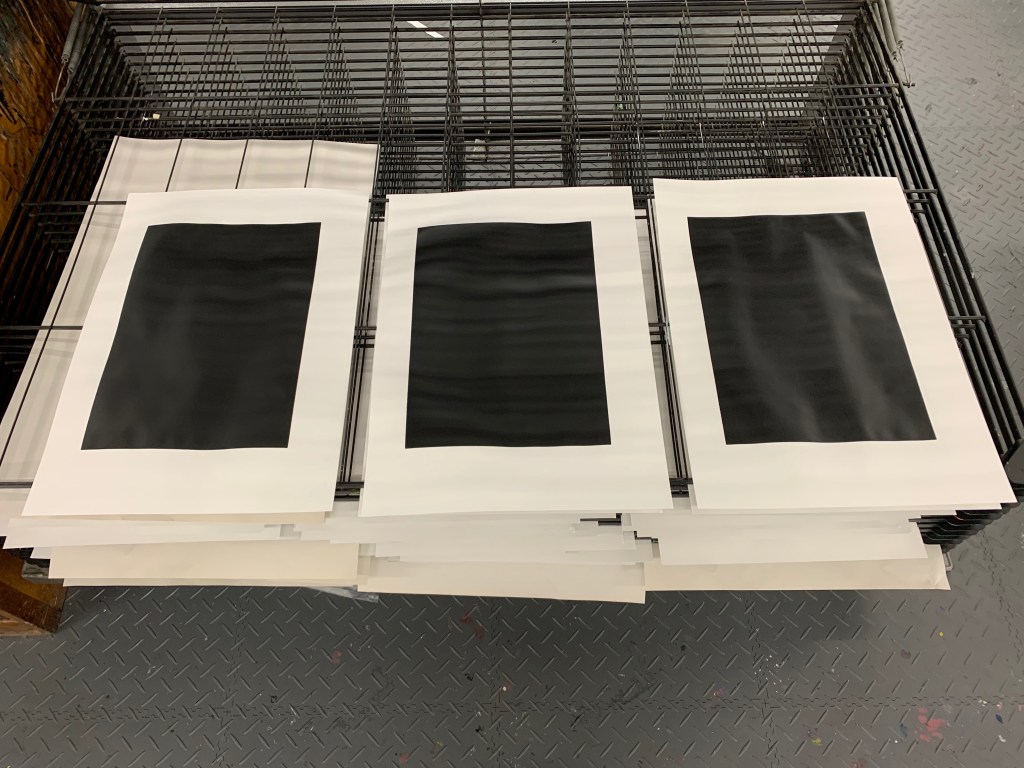
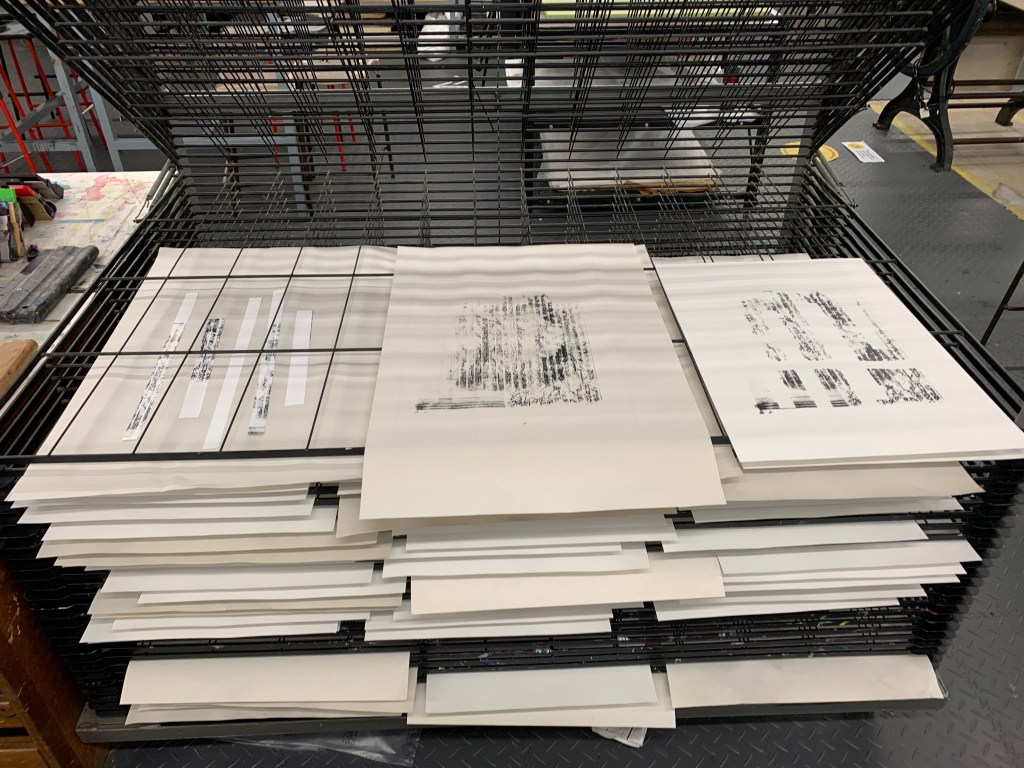
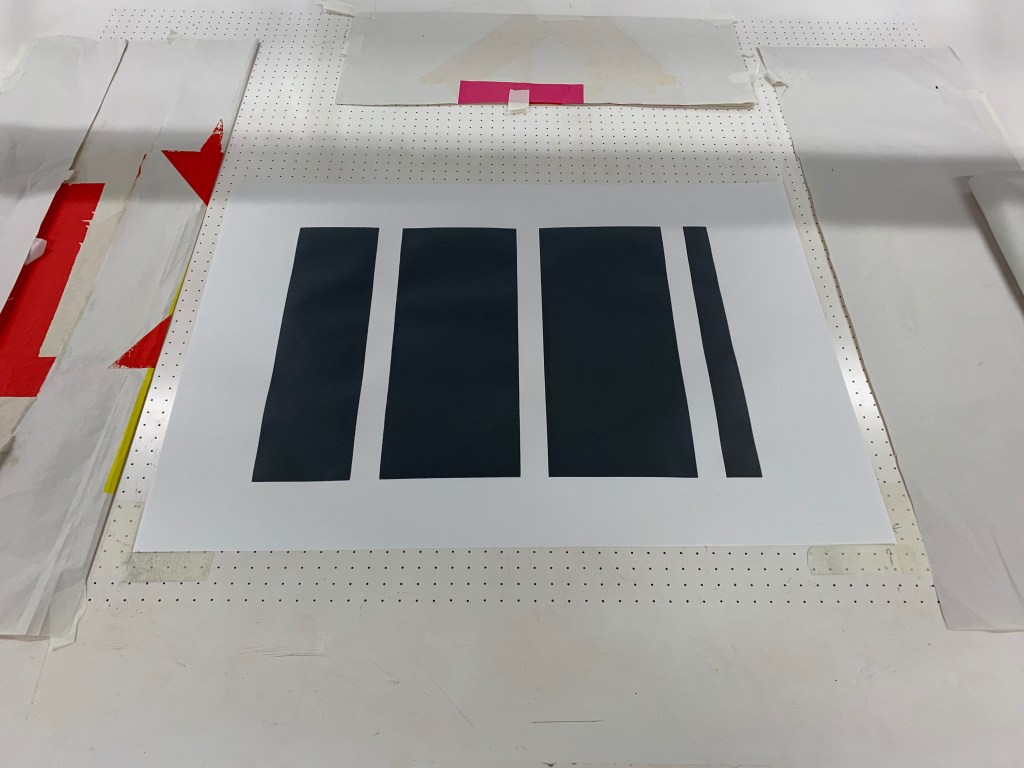
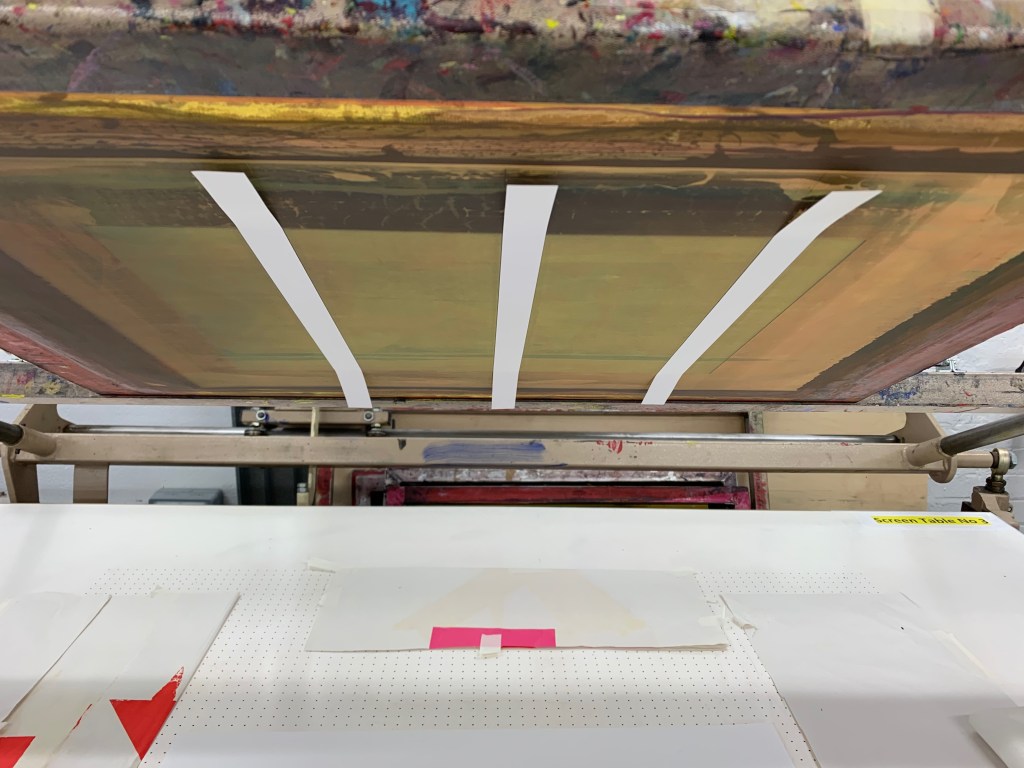
One of the most difficult processes when screen printing various layers is when a large block of colour is required. This is due to the constant pressure required to pull an even print without blemishes. Sometimes, the squeegee is pulled more than once to achieve a consistent application of ink. With time and practice I was able to achieve consistent blocks of colour which would then be used to print on top of. When I was looking at the number of prints drying, all looking the same, I wanted to break this up and dislocate the surface. I was learning how to make editions and this would certainly assist me in producing editions to sell, which will form part of my business plan after graduating. However, the main goal is to explore the various processes I am employing and how these can be used to make one-off unique works. An element that was surfacing in my work and that I liked and wanted to exploit further was the braking up of the image. I therefore would use sections of newsprint, card, and paper to mask off areas. This would break up the print and would also result in the masking material to have a section of print transferred to that surface. The masked sections that have no ink applied I find just as interesting as the areas where ink has been applied. The prints take on a whole different feeling and are broken up into component parts. This for me is exciting and provides further possibilities for these fragments to be used for other works.
Test prints drying from masking different areas of the printMasked printStrips of glossy card applied to the screen for masking Four A4 prices of paper placed on the screen bed for taking the print
Working through this process of experimentation by masking off different areas and using more than one sheet of paper to apply the print was exciting. I felt less restricted by having to produce perfect prints that were totally the same; working instinctively gave me an energy and provided lots opportunities and points off departure for me to work from. I felt a way forward was being revealed to me where working with the process of masking and fragmenting the prints was a way to approach my final works. The prints were being broken up into what felt like a form of language, where sections of pixelated syntax was being revealed. This language that was manifesting was the language of the process where the work had gone through the digital to produce the prints. It was signifying the relationship between digital and physical process and how the work appeared once it traversed these areas.


 Marco Carofalo ART
Leave a comment