The work of Mark Bradford has been very informative to me, in terms of how I view my hybrid prints. Bradford is best known for his large-scale abstract paintings created out of paper; there is an instant relation to my work with the use of this material that he leverages like paint. His characteristic layered format provides me with ideas of how I can develop and build the composition in my work. I like the idea of recycling the prints I have made onto other surfaces much like the way a collagraph plate is constructed.
        I like that Bradford uses everyday materials and tools from the aisles of the hardware store, which again, has similarities with my practice. I will use found sections of plywood that have been used in the construction of a building or leftover household paint. I like that these materials can find another function. Bradford repurposes paper from the outside environment that will have social meaning, such as merchant posters that advertise predatory services in economically distressed neighbourhoods. These are then transferred to the inside where they are glued onto canvas. Bradford will then work on and around these fragments using other materials and paper. What I particularly admire is when this new surface full of meaning and geographic significance is disrupted creating something new that will provide zones that communicate these topical hidden identities.
Spoiled Foot, mixed media on canvas, lumber, luan sheets and drywall
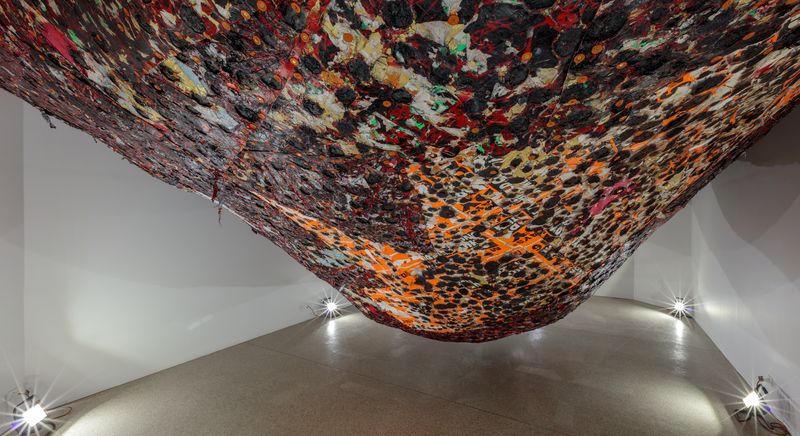
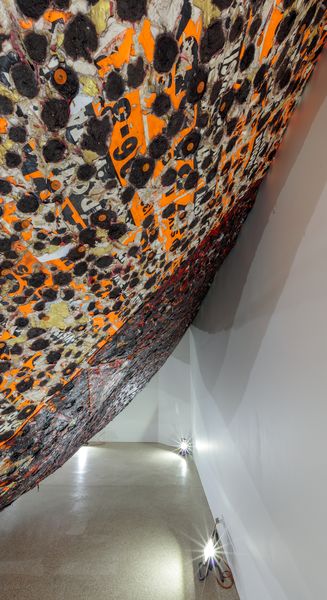
When looking at Bradford's work a number of pieces were installed conventionally on the wall, however, what appealed to me more and got me thinking about how I could present my work was his exhibition at the 2017 Venice Biennale, Tomorrow is Another Day, US Pavilion. There is this giant mass made from papier-mâché that hangs from the ceiling and restricts the space. The viewer is channeled to come in close proximity to the work and cling to the walls. I like that the ceiling is used to install the work but still brings the walls and floor into play.
Image detail
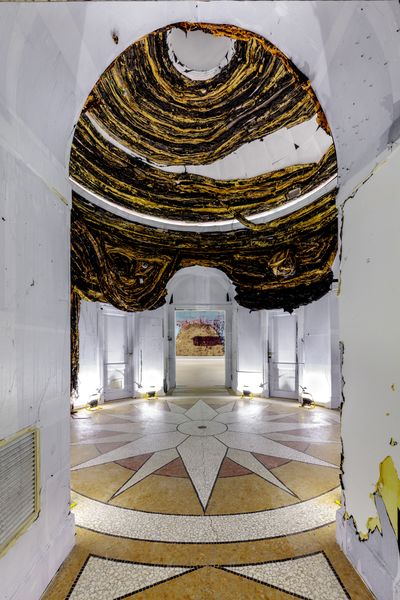
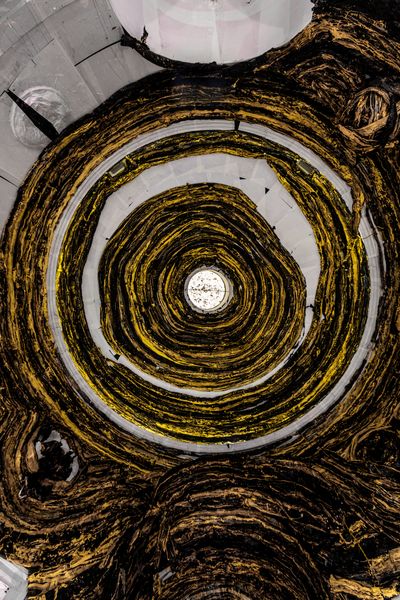
The other work that stood out to me was Oracle which encompassed the rotunda. Bradford totally transformed the space by peeling away the plaster from the walls, much like his layered canvas works. Ropes of painted-and-bleached black-and-gold paper where pasted up on the ceiling, transforming the space into an eerie ruin. This made think of how my work could cling to the architecture of the room or interact with the fixture and fittings, much like my cast paper print of the studio radiator. I had also been taking rubbings of the surfaces in the studio space when I first came into contact with the space; it was a way for me to physically interact with the space and engage my body in the making process. Could I make rubbings of the whole space and construct these is some way?
Installation view of Oracle in the Rotunda of the US pavilionDetail view
What I ultimately liked with the work was that it shifted the viewers perspective and makes me consider how I can introduce this into my work. I am amassing an inventory of test prints and fragments of newsprint that contain sections of images and want to be able to repurpose them, extending the life of the work, acting as a workable layer in subsequent prints. Could I experiment with the size of these fragments and have them displayed in areas of the room that would not appear to be obvious at first? They would almost hide and require the viewer to seek them out, like a sliver being installed under the window ledge in the studio or on the ceiling? This is an exciting prospect and something I look forward to exploring as I progress my work.

 Marco Carofalo ART
Leave a comment