To develop my investigations further, complementing the Tracey research that will aid my investigations into drawing and space. Anna Lovatt produced an essay for the Drawing Sculpture Exhibition in 2013 which was a partnership between Drawing Room, London and Leeds Art Gallery. Although the focus is on the relationship between drawing and sculpture the categories that Lovatt highlights can be adapted to my project, allowing me to consider how my work on paper can evolve. Lovatt is attempting to go beyond the trope of “drawing in space,” and explore how the two practices interact, investigating structure, scale, surface and slightness. I feel this investigation can provide me with clues for my practice and be assigned to the role of printmaking and the relationship to drawing. I'm keen to give my work a structure and therefore the relation to sculpture can provide areas to consider in terms of presentation. When I think of drawing, this activity is not flat, it has a mass, although minute the material left on the tooth of the paper when drawing leaves a raised surface. When I observe my marks, there is an indentation in the paper, thus providing a sculptural quality to the work. Running my finger over the divots make me feel in-tuned with the material.
        Lovatt proceeds to discuss the resurgence of drawing as a primary means of production that relates to my work and forms the basis of my activity, I interpret drawing not just as the physical mark made with a pen or pencil but by the process of folding; therefore the paper begins to build a structure and becomes more sculptural. This unlocks possibilities for the work to come away from the wall in terms of display and encounter the rest of the exhibiton space, the whole room is up for grabs!
        Lovatt views drawing as a way to travel across mediums with its relation to mathematics, architecture and painting. "untroubled by modernism’s erstwhile obsession with purity and autonomy."

Writing in 1971, Lucy Lippard observed: “What has happened since [1967] is that the pictorial impetus in sculpture has been dematerialized and has often taken the form of drawing, either literally, on surfaces, in space, or on the ‘ground.’ The question is, and I can’t answer it, whether such drawing or pictorial effects in real space are essentially bad, dishonest, untrue to the internal necessities of something called sculpture.”

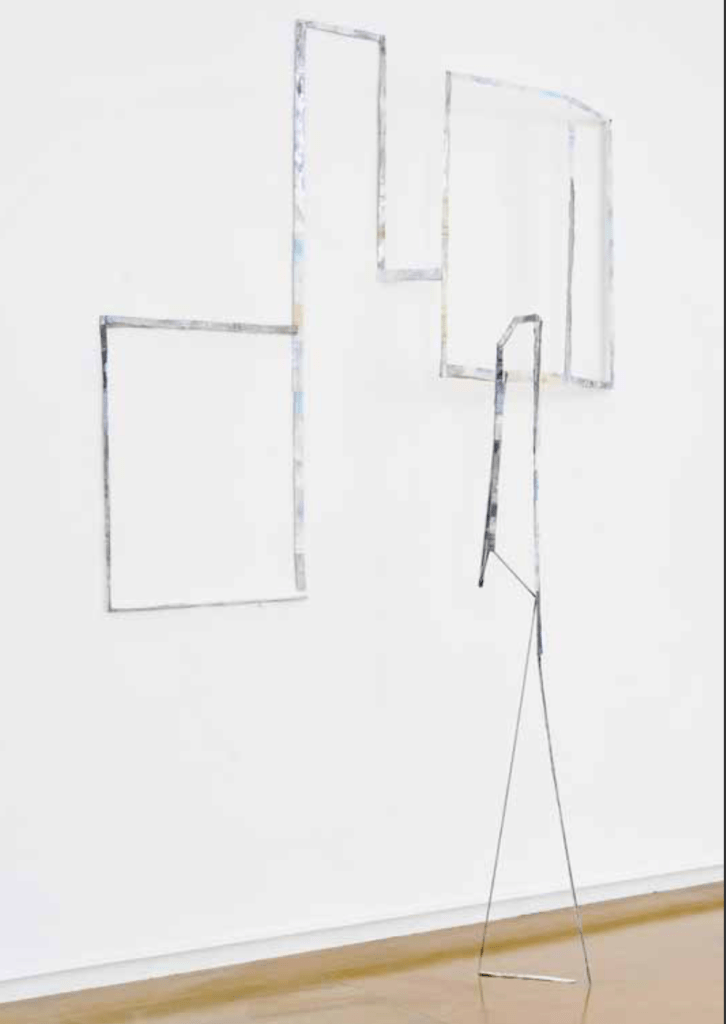
The emphasis on “structure”  was important to get me considering how my works could manifest, Lovaat makes reference to the broader connotations to this phrase, pertaining to the organisation of almost anything, including concepts and texts. The work of Sara Barker has a distinct anatomy, having all the appearance of a linear drawing, referring to the articulation of imaginary and moves out into the space. What I like with her work is how it appears whole and yet at the same time fragmented. The metal is fixed and layered and allows the viewer to move around the work. I can imagine how areas reveal and conceal themselves which makes me consider how works can be hung, like my folded prints, leveraging the two-sided imagery.
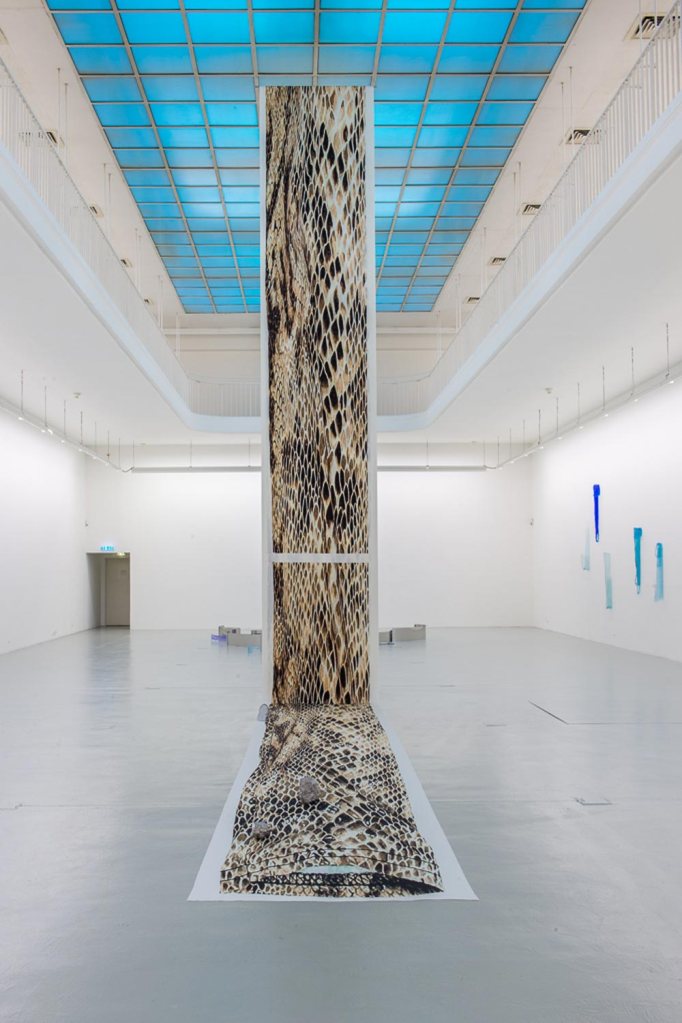
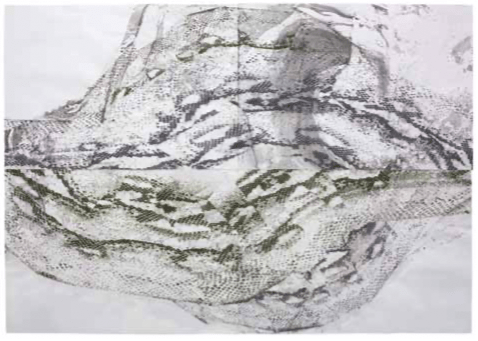
        Alice Channer's work I find highly interesting and offers potential for how I may replicate my prints, in order to pick out areas of interest. Stretched Skin was made by photocopying sections of a snakeskin-print trouser leg. The resultant fragments were then reassembled, scanned and digitally manipulated, distorting and distending the pattern still further. I love the movement of process where the work is re-engaged by the body after the digital/mechanical steps, where the image is traced by hand in ink and graphite. I like that the physical is reproduced into something flat that allows for a totally different mode of display. I love the work below, where similar fabric has been printed on a large, stretched scale to produce something totally different. Something synthetic is appearing organic.
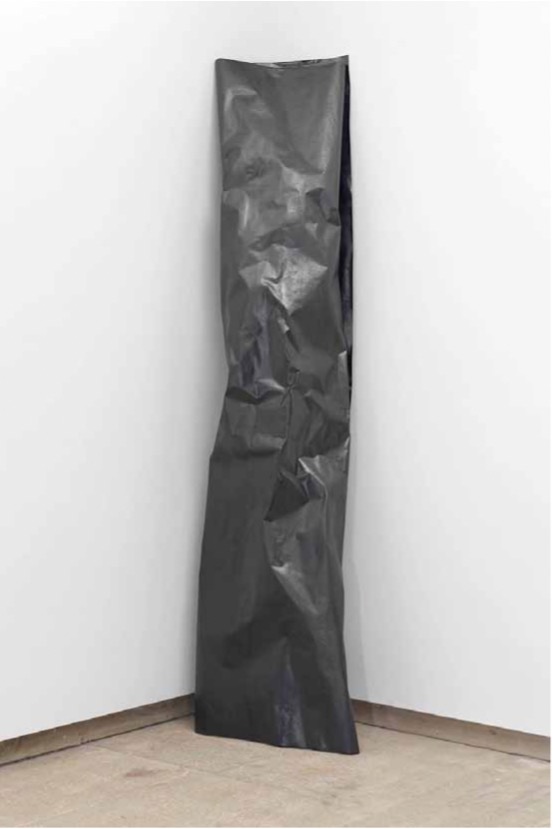
        The work of Anna Barriball was considered when discussing surface. This relates directly to the research I identified by Duncan Bullen on the Tracey Drawing Research Network which connects to my initial rubbings of the studio space. Barrball's work stresses the importance of contact with the surface of paper. Her work is a finding exsercise of the surface of things, such as windows, doors, shutters, or a fireplace. Covered with paper, they are rubbed hard with the tip of a pencil or pen until individual strokes coalesce into a single weighty, metallic membrane. The last stage of the process relates again to the body, where she will wrap the worked sheet around her body. This newly emerged structure can then be positioned into the space taking on a totally different relationship to the environment; it looks like it should not be there but needs the space to lean and present itself to the viewer.
Alice Channer, Tsunami, 2013, digital print Sara Barker, Representing a Sketch, 2012, aluminium sheet, stainless steel round bar and various paints Alica Channer, Stretched Skin, 2011, Graphite and Coloured Pencil on Hand Marbled Paper Anna Burnball, Untitled II, 2008, Ink on Paper

 Marco Carofalo ART
Leave a comment