Printmaking has been a practice I have immersed myself into the past couple of years, as I have embarked on my academic journey to get my Fine Art Degree. Before Starting London Met I was thinking ahead to my dissertation and how my practice could develop. I was intending to instigate a practice-led piece off research that would link into my studio practice. Drawing's relationship to printmaking has fascinated me and appears to be a core component, I wanted to explore the relationship between printmaking and drawing. In tandem with this, another aspect has surfaced in my practice which was responding to a particular space I was working in. I therefore felt researching Phenomenology would be a good place to start and came across Loughborough University's Tracey Drawing Research Network that I became a member of.
The presenters responded to the following suggestions as starting points in the discussion, as possible themes, prompts and provocations:
What is the relationship between the physicality of drawing and lived experience?
When viewing drawings, is it possible to trace the movement of a drawer’s mind/body?
Are all drawing processes phenomenological?
How can drawing trace the physicality of spaces?
What are the limitations of drawing?
Is materiality a necessity in drawing the trace of lived experience?
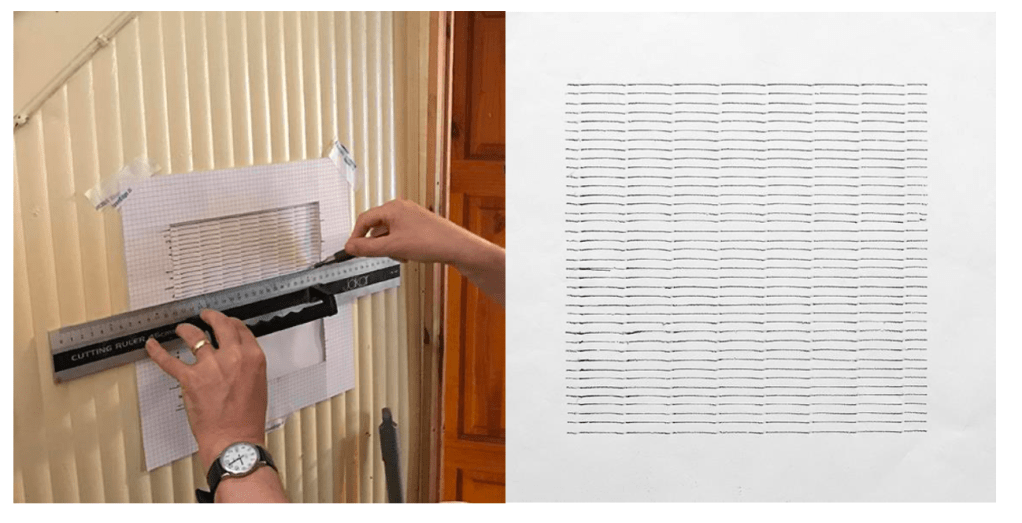
Breath drawing no16, Gordon house, 2018.Breath Drawing no22, Gordon House, 2018.
The above images are from Duncan Bullen's research, by drawing in a space as a meditative process.  Bullen was specifically working in sites of transition. The above images are from his breath drawings made at Gordon house, Margate, a space that was due to be renovated. I liked the idea of working in an area that was due to change completely; what would remain of the original space, how would the feeling of imminent change affect that of the inhabitant? Bullen limited his working practice by attempting to ignorer the aesthetics of the environment in order to stay close to the fabric of the building and the material he was using to draw on. Bullen wanted to remove artistic decisions and in his own words 'reside in the background'. The drawings were made by positioning 30x30cm prepared paper to uneven surfaces and then placing a 20x20cm gridded window over the paper. Using the grid to draw the lines, all compositional decisions where removed, using the same HB pencil and ruler to make the marks. Each line was made on his in-breath, the correlation between breath and drawn line is interesting, I can imagine all sense of the space dissipating and was more about the action than the space itself.
        This for me was a type of printmaking that relates directly to drawing (frottage). This was an activity I used in my first week in the studio. It was quite overwhelming coming into the space for the first time, arriving early and being the only presence in the room. The activity of taking a direct impression of the surface instantly made me connect to the space and relieved all that sense of anxiety. I feel this process directly engages the body; the closeness to the architecture, the holding of the paper and the activity of vigorously rubbing graphite over the epidermis of the building is intriguing. How could this be adapted? Can I take rubbings of the floor and walls, creating something that situates itself in relation to that very space. Could the rubbed surfaces be positioned just in front of the real surfaces and create a room within a room? There are interesting possibilities that arise from considering this simple yet effective way of drawing/printmaking.


 Marco Carofalo ART
Leave a comment